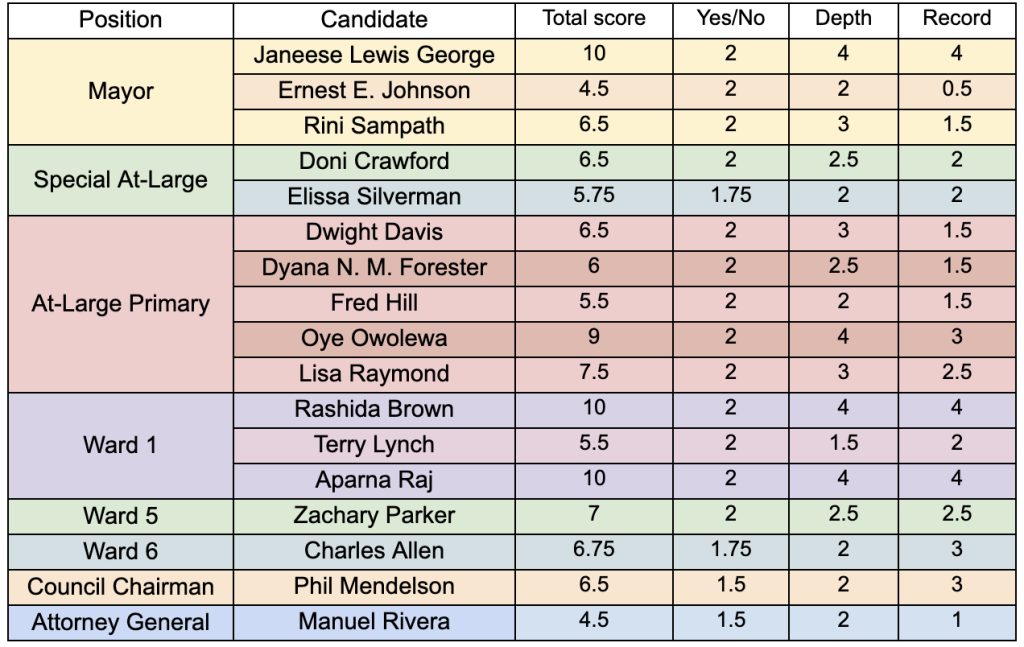
GLAA is proud to announce its ratings for the candidates of the 2026 D.C. Council Primary Elections. We invited all candidates running for local office to answer questions based on the 2026 GLAA Policy Brief: Back to Basics. We rank the candidates’ responses to our questionnaire according to whether they (a) responded affirmatively or not, (b) how much depth and clarity they had in their answers, and (c) how their shared track record reflects the stance they are defending. Upon deliberation, candidates are assigned a score that is converted to a number between -10 and 10.
Candidate Scores
Mayor
Janeese Lewis-George (10) – Janeese’s responses were detailed, thorough, and demonstrated the practical knowledge and understanding of an experienced policy maker. Her record is well represented throughout, including links to relevant articles on the issues–she has been a leader on many of the issues in the brief. She agreed with GLAA on all the issues except decriminalizing sex work.
Ernest Johnson (4.5) – Ernest’s answers were clear and definitive, but lacked much detail or specific track record on actions for the issues in the brief. He gave examples of potential policy actions he would take as mayor, if elected. We appreciate that he mentioned ways to increase revenue. He agreed with GLAA on all the issues.
Rini Sampath (6.5) – Rini’s answers were detailed and thorough, with nuance and creativity in her approach to some issues. Most responses demonstrate depth and clarity. She had an enriching perspective. However, she described little of her record and did not always make clear connections between her past actions and the issues in the brief. She agreed with GLAA on all the issues.
At-Large Special Election
Doni Crawford (6.5) – Doni provided good answers, but with less depth than expected from a sitting councilmember. Despite her years of experience in the policy realm, she shared little about her record. However, a few of her answers included more substance and concrete plan, and generally she was clear and succinct. It was refreshing that she identified ways to increase revenue. She agreed with GLAA on all the issues, though her position on “Invest In a Just Legal System” could have been clearer.
Elissa Silverman (5.75) – Elissa answered most questions with more than a simple yes or no, but generally the substance of the answers and description of her record were not what we expect from someone who had two terms as a councilmember. GLAA is aware of the candidate’s record on these issues and expected to see more details of these votes and actions on the brief’s issues. She consistently advocated for some issues in the brief and she vigorously pursued oversight of DC agencies. She agreed with GLAA on all the issues except decriminalizing sex work, and she did not address the need to revert DC’s pretrial detention laws to the pre-2023 evidence-based standard.
At-Large Primary
Dwight Davis (6.5) – Dwight’s responses showed great passion and moral clarity. His answers demonstrate a clear point of view, but in some places lack the demonstration of record of actions on our issues. On a few points, he did go into greater depth. When he provides detailed recommendations, they are specific and measurable policy levers. He agreed with GLAA on all the issues.
Dyana Forester (6) – Dyana’s answers demonstrate understanding and support for the issues, but would benefit from more specific examples or policy details. Her record of working on behalf of the community is clear but she failed to make strong, detailed connections to the issues in the GLAA brief. She agreed with GLAA on all the issues.
Fred Hill (5.5) – Fred gave clear definitive answers, and he provided an overview of his background as an opening, which was helpful to understand his record and context. We wish more candidates took that approach. He describes a record of public service, but he could have gained more points on his depth score if he had provided specific examples applying his expertise to the issues in the brief. He agreed with GLAA on all the issues.
Oye Owolewa (9) – Oye’s answers are generally strong with clear examples of actions from his record that are responsive to the questions. He demonstrated a deep understanding of the interconnectedness of the issues in the brief and how they impact the lives of LGBTQ+ people in DC. He showed creativity and novel approaches to issues with specific examples of policy solutions. He agreed with GLAA on all the issues.
Lisa Raymond (7.5) – Lisa also provided a strong introduction to her background and record. She gave very specific answers to some questions that identify potential policy levers. In depth, she has a clear sense of what she can do in office to influence the issues. She agreed with GLAA on all the issues.
Ward 1
Rashida Brown (10) – Rashida’s responses were remarkably comprehensive. She has an extensive record of leadership, demonstrating great depth of experience and knowledge on nearly every answer. She connected issues and identified multiple practical ways to improve the health and wellbeing of DC’s communities. We wish she had spoken to the issues of access to legal services. She agreed with GLAA on all the issues, other than omitting any reference to the access to justice programs.
Terry Lynch (5.5) – Terry’s answers were concise and passionate, thoughtful and empathetic. His record includes relevant experiences and deep knowledge of a few of the issues in the brief. He agreed with GLAA on all the issues.
Aparna Raj (10) – Aparna’s responses were detailed and comprehensive, with many creative and insightful connections throughout. Her record demonstrates a history of organizing DC’s communities in pro-democracy actions and for the betterment and human rights of neighbors and workers. She shared concrete next steps to achieve her policy goals. She agreed with GLAA on all the issues.
Ward 5
Zachary Parker (7) – Zachary’s answers were succinct, but demonstrated a record of action issues in his time as a member of the Council. His responses drew some connections between issues, and he could have gone into greater depth on many of them. He agreed with GLAA on all the issues.
Ward 6
Charles Allen (6.75) – Charles’ answers were thoughtful and clear, demonstrating a strong record of experience as a councilmember with a long history of action on issues in the brief. However, we expected greater depth for a multi-term councilmember on some of the answers. In a few instances, his answers were not fully responsive to the question. He agreed with GLAA on most of the issues, with caveats or partial answers on Invest In a Just Legal System, Power to the People, and Fight Crime At The Source.
Council Chair
Phil Mendelson (6.5) – Most of Phil’s responses were generally good, with concise accounts of his actions on the issues in the questionnaire. As incumbent council chair, Phil has a leading role in promoting the rights and wellbeing of DC’s LGBTQ+ community. Phil lost points for not identifying creative ways for the DC Council to support access to Alliance, Medicaid, or SNAP benefits in light of federal cuts. He gained points in consideration of his long-standing record of support of LGBTQ+ civil and human rights.
Attorney General
Manuel Rivera (4.5) – Throughout Manuel’s responses he demonstrated compassion and dedication to DC communities. Some of his responses lacked detail and he did not have much record on some of the issues in the brief. We appreciated his description of his background, though it would have benefited from more direct connections to the issues. He agreed with GLAA on most issues, except decriminalizing sex work and his positions were somewhat muddled on Invest In a Just Legal System and Safe and Warm Homes.
About Our Ratings
The ratings are based solely on the issues and may not be interpreted as endorsements. Founded in 1971, GLAA is an all-volunteer, non-partisan, non-profit civic organization. GLAA serves as a network of people committed to defending human rights and advocating for the advancement of LGBTQ+ people in the District of Columbia. GLAA is the nation’s oldest continuously active LGBTQ+ civil rights organization.
A candidate with a score of 10 is someone who is in agreement with all the policies presented in the brief, giving thorough answers that show they understand the issues, while presenting a track record that shows proof of their commitment to the causes.
GLAA thanks all the candidates who responded to our questionnaire.
The candidate’s responses are available below.
Questionnaire Files:
Mayor
At-Large Special Election
At-Large Primary Election
DC Council Ward 1
DC Council Ward 5
DC Council Ward 6
DC Council Chair
DC Attorney General
NOTE: GLAA believes that elected officials are stewards of the public trust and therefore must hold themselves accountable to the highest ethical standards. GLAA, therefore, will not issue any rating for candidates who, in their capacity as elected officials, were expelled from any elected post, or resigned, for ethics violations that include, but are not limited to, conflicts of interest, self-dealing, and malfeasance.